


A business’s external attack surface is often larger than expected. In fact, so much of an organisation’s data is publicly accessible that hackers can map out a business using only publicly available information.
The truth is, everyone wants to stay safe from hackers’ exploits. Still, the only way to defend proactively is to understand how, when and why attackers might target your organisation and what they can achieve using publicly available information.
This blog will help you to view your organisation from the perspective of a malicious actor, enabling security teams to improve their external attack surface management through a better awareness of your external assets.
What is your external attack surface?
An external attack surface refers to all of the internet-facing assets and public-facing components of your business. These include:
- Domains
- Subdomains
- APIs
- Cloud assets
- Public-facing web applications
All of these assets are gateways to your internal systems that can be exploited; therefore, they must be considered security risks and vulnerable from an attacker’s perspective.
Without proactive security measures in place to efficiently manage these assets, businesses could become vulnerable to critical risks, financial sanctions, compliance issues, and diminished customer trust.
Knowing what might tempt a hacker to exploit is essential for ensuring your security policies are well-targeted to protect your external-facing assets.
What can hackers find out about your business online?
Hackers can gather a vast amount of business information from public data, leaked credentials, and misconfigured online systems, before even needing to ‘break in’. Organisations unintentionally expose sensitive information through poor security hygiene and digital footprints.
This information can feed targeted phishing, fraud, and technical attacks specific to your business, making employees more vulnerable to exploitation.
Here are some of the key assets attackers can find out about your business online, and how they could be utilised against you if left exposed.
Public website, DNS and domain data
Public website, DNS, and domain data provide attackers with a blueprint of an organisation’s infrastructure. DNS records and subdomain enumeration reveal mail providers and forgotten development servers. SSL/TLS certificate transparency logs expose every hostname and subdomain, including those administrators may have overlooked.
Open ports and exposed services leak software versions and potential vulnerabilities through service banners. Historical data from Archive.org and search engine caches preserve deleted login pages, deprecated endpoints, and sensitive content that organisations believed they had removed.
Employees, roles, and internal workings
While LinkedIn is great for hosting your professional activity and job history, it also clearly documents the names, roles, reporting lines, and oversharing that fuel social engineering.
For example, a hacker could easily see you are a Senior Developer at X organisation, reporting to X, and use that to craft a convincing phishing email.
The level of personal detail found on someone’s LinkedIn, such as specific mentions of their responsibilities, adds to the legitimacy of the phishing email, making it more likely an employee will not recognise a scam and be exploited.
Credentials, accounts, and technical footprint
Leaked credentials in data breaches are essential to consider when assessing your attack surface. Domain-wide searches on breach databases like HaveIBeenPwned reveal compromised employee passwords, which, through reuse, often unlock corporate systems. Public cloud storage misconfigurations, such as open S3 buckets, Azure blobs, and exposed databases, frequently leak customer data, internal documents, and credentials.
Code repositories on GitHub and GitLab inadvertently expose API keys, authentication tokens, and environment files containing production secrets. Specialised search engines index exposed servers and IoT devices, revealing authentication panels, databases, and management interfaces directly accessible from the internet.
Sensitive assets and reputation data
Even publicly accessible documents like maps and diagrams revealing processes, facilities, or architecture can be potential vulnerabilities.
Third-party integrations and supplier portals extend your attack surface beyond systems you control, as partner-hosted services become entry points for attackers targeting the weakest link in your supply chain.
Mentions of your brand, staff, or domain on underground forums and dark web markets reveal stolen credentials and planned attacks, whilst fake profiles impersonating employees can also lead to phishing campaigns and fraud that cause security incidents and reputational damage.
These threat exposures can provide attackers with valuable intelligence to exploit your organisation’s weaknesses, making it essential to monitor and manage them proactively. Understanding these external risks helps strengthen security posture and protect sensitive data from emerging threats.
What is external attack surface discovery?
External attack surface discovery is the process of identifying all external-facing assets that belong to a business so they can be assessed and secured. It is the first phase of external attack surface management (EASM) and includes both known and unknown assets for later assessment and security.
It’s an essential step in effective vulnerability management and identifying external threats, and can help significantly in gaining a thorough understanding of exposure management.
How does external attack surface discovery work?
Seed-based scanning
Discovery begins with a few known seeds: your organisation’s main domains, registered IP ranges, cloud accounts, or existing SSL certificates. These initial data points form the foundation for mapping your external attack surface.
Recursive discovery
From these seeds, scanning tools follow relationships to uncover further assets.
They trace DNS links, enumerate subdomains, follow redirects, and analyse service responses. This recursive process fans out from a single domain to reveal hundreds of related hosts, forgotten services, and third-party endpoints.
Each discovered asset becomes a new starting point, creating a cascading discovery process that maps the full scope of your internet-facing exposure.
Data sources
Attack surface management tools gather intelligence from DNS and WHOIS records, certificate transparency logs, internet-wide port and service scans, cloud provider inventories, public code repositories, breach databases, and historical web archives.
These are the same sources attackers consult during reconnaissance. The key distinction lies in intent and automation.
While security teams use these tools to discover and remediate exposures proactively, threat actors leverage identical intelligence to identify exploitable vulnerabilities. Both operate from the same data pool: the advantage goes to whoever acts faster with better automation.
Discovery of unknown and shadow assets
Explain how this process surfaces assets security teams didn’t know they owned: forgotten subdomains, legacy apps, unsanctioned cloud storage, cloud environments, exposed APIs behind partners, old code repos
How can external attack surface discovery and penetration testing work together?
Attack surface discovery gives organisations a full map of their exposed assets, while external infrastructure penetration testing focuses on safely exploiting the most promising paths.
Attack surface discovery might reveal a forgotten admin subdomain or an exposed S3 bucket containing configuration files, which penetration testers then validate by attempting to access the admin panel or retrieve sensitive data from the bucket.
This collaboration ensures identified assets are not just catalogued but actively tested to confirm whether they represent genuine security risks that require immediate remediation.
By running both external pentesting and attack surface discovery together, organisations can more efficiently improve their security posture, directing their efforts towards high-risk findings rather than guessing where to start.
Continuous monitoring via vulnerability scanning tools can also provide an excellent addition to any security operations, providing your organisation with an overview of your security posture between tests.
External Attack Surface Management: What Can Businesses Do Now? Quick checklist
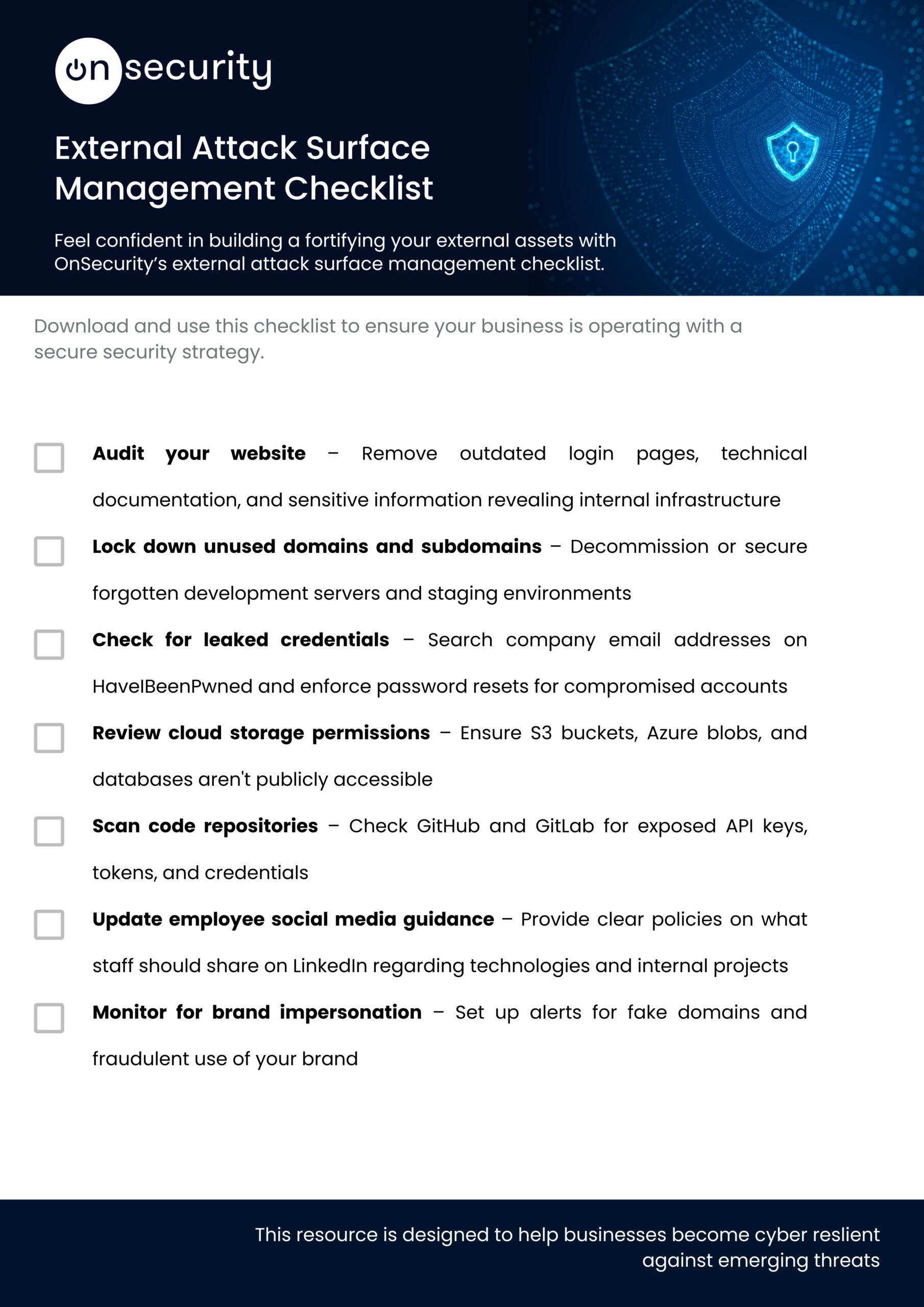
Protect against external attacks with OnSecurity
Secure your organisation’s digital assets and prevent attackers from gaining access to your networks with OnSecurity’s external penetration testing services. Our consultative-based platform is designed to support you in proactively managing evolving threats towards your internet-exposed assets, identifying security gaps through testing your external exposure.